
How to Choose a Digital Marketing Agency in 2026
If you’re figuring out how to choose a digital marketing agency in 2026, you’re not alone. Most teams start this search because something feels off, traffic is up but revenue isn’t, reporting looks “busy” but decisions still feel like guesswork, or you’ve been burned by a vendor that promised results and delivered… spreadsheets.
Here’s the reality: in 2026, you’re not hiring someone to “run marketing.” You’re choosing a partner to help you build revenue infrastructure, the systems, tracking, and execution that turn attention into pipeline and pipeline into closed-won growth.
This guide gives you a clear checklist so you can shortlist agencies fast, ask sharper questions, and walk into your strategy calls knowing exactly what “good” looks like.
Quick Answer: The 2026 Agency Selection Checklist
If you only read one section, read this. A great agency in 2026 will feel less like a “marketing vendor” and more like the team that helps you connect the dots between channels, tracking, and revenue.
Choose a digital marketing agency that can:
Tie marketing to revenue (CAC, pipeline, closed-won't just “more traffic”)
Show up where people actually search (not just traditional Google rankings)
Execute AEO so your brand earns citations and mentions in AI answers
Use AI to move faster with humans accountable (a clear human-in-the-loop policy)
Build a first-party data strategy that survives privacy changes
Prove ROI with MMM + incrementality testing, not platform-reported ROAS
Provide live dashboards, transparent access, and clear ownership of assets
Present a realistic first 90-day plan with measurable milestones
Why Choosing an Agency Got Harder and More Important in 2026
A few shifts changed what “good marketing” looks like:
Marketing moved from tactics to “revenue infrastructure”
The job isn’t just running campaigns, it's building a system that can be measured, optimized, and explained with confidence.
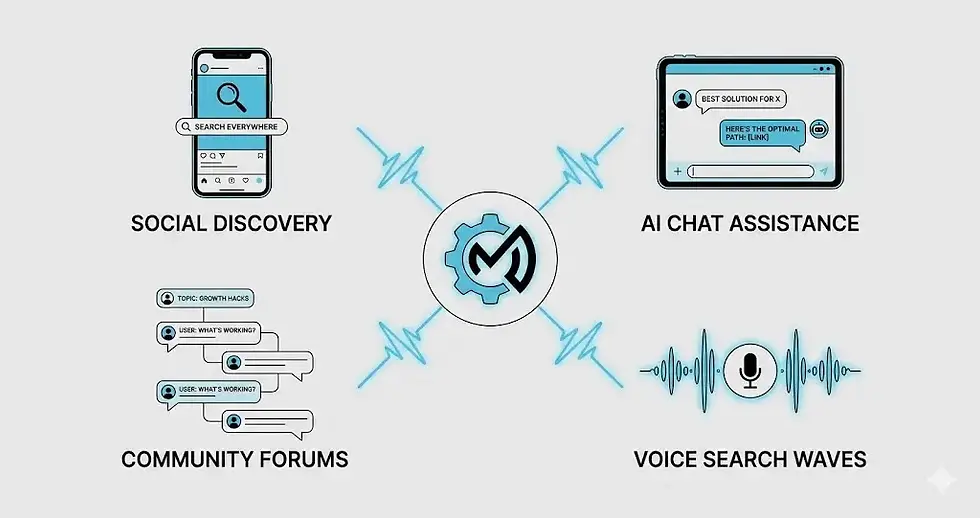
Search Engine Optimization is now “Search Everywhere Optimization”
Discovery is fragmented (AI tools, social platforms, communities, and traditional search). A growing share of searches are zero-clicks. People get the answer without visiting a site so agencies need a plan for visibility that doesn’t rely on “ten blue links.”
Privacy is no longer optional
With third-party signals fading, the brands that win are the ones that own their audiences and data. The agency you choose should treat privacy and data governance like performance fundamentals not legal fine print.
Step 1: Define “Definition of Done” Revenue Goals Only)
Before you speak to agencies, define what success means in business terms.
The problem is most businesses hire agencies with vague goals then get vague outcomes. And when leadership asks, “What did we get for this spend?” Nobody has a clean answer.
Instead of:
“Increase traffic”
“Grow social”
“Improve SEO”
Use:
“Reduce CAC by X%”
“Increase qualified pipeline by $X/month”
“Increase closed-won revenue attributed to marketing”
“Improve conversion rate from lead → booked call → closed-won”
If an agency doesn’t push you toward revenue, CAC, and pipeline, keep looking.
Step 2: Choose the Right Type of Agency Specialized vs Full-Service
There are two broad paths:
Specialized agencies (SEO only, paid media only, CRO only) are great if you already have an internal strategy leader and just need execution “muscle.”
Full-service agencies are built for businesses that want one partner across the funnel strategy, execution, measurement, and optimization.
Because you’re aiming for national reach across all 50 states, full-service marketing matters. The real question isn’t “Do you offer SEO and PPC?” It’s: Can you run these together under one revenue measurement model?
Step 3: Vet Their Visibility Strategy Beyond “Google SEO”
Ask this directly:
How do you optimize for visibility in AI overviews and answer engines, not just traditional search results?”
In 2026, agencies should be fluent in:
Answer Engine Optimization: structuring content so AI systems can extract and reuse it
Multi-platform discovery: visibility across the places people actually research and decide
What you’re listening for:
A plan for earning “mention share” and “citation share,” not just rankings
Clear content structure principles (question-based headings, direct answers, schema/metadata)
A focus on authority signals (experience, expertise, trust)
Step 4: Test Their AI Maturity (Agentic vs “We Use AI”)
AI is everywhere. That doesn’t mean it’s being used well. A modern agency should be able to explain how they use AI for:
analysis and pattern detection
debugging or automation
personalization at scale
but also explain their human-in-the-loop policy for accuracy, compliance, and brand voice.
Ask:
“Where do you use AI in your workflows and who is accountable for the final output?”
“How do you ensure brand consistency when using autonomous AI agents for content?”
“What’s your policy on AI transparency?”
A simple gut check: it’s fine if an agency uses AI to draft content or generate creative variants but someone should still be responsible for accuracy, voice, and “does this sound like us?” If they can’t explain that review step, you’re not hiring a team, you're renting a content generator.
Step 5: Don’t Settle for Surface-Level Measurement (MMM + Incrementality)
Attribution is fragmented in 2026. If an agency can only show:
platform dashboards
“last click” conversions
isolated ROAS
you’ll struggle to prove what’s actually working. Look for two capabilities:
Marketing Mix Modeling (MMM)
A privacy-resilient way to connect marketing inputs to business outcomes (and forecast performance so you can adjust budgets mid-cycle).
Incrementality Testing
Geo splits or “natural experiments” to separate what marketing caused from what would have happened anyway.
Ask: “Do you use business driver modeling or just platform-reported ROAS?”
Bonus points if they integrate MMM + testing into budgeting decisions, not just reporting.

Step 6: Make Compliance a Competency
A strong 2026 agency should be able to act as a technical compliance partner, especially around:
first-party data strategy
opt-out mechanics and consent governance
transparency around synthetic / AI-generated content in workflows
If an agency seems uncomfortable here, that’s a risk, not just a weakness.
Step 7: Replace “Pitch Theater” With Proof
Ask for proof in formats that are hard to fake:
Live dashboards (not just PDFs)
direct access to accounts (or clear ownership terms)
examples of how they diagnose issues and make decisions
A polished deck is easy. A working measurement and execution system is not.
Step 8: Use These Interview Questions
These questions quickly separate real operators from smooth talkers:
Strategy: “If website traffic dropped 20% overnight, what’s your diagnostic checklist?”
Budget discipline: “How do you determine when a channel should be scaled down?”
AI policy: “How do you ensure brand consistency when using autonomous AI agents for content?”
Measurement: “How do you handle attribution in a zero-click, privacy-first environment?”
Tip: ask for a real example using the S.T.A.R. method (Situation, Task, Action, Result). You want decisions and outcomes not theory.
Step 9: Red Flags That Should End the Conversation
If you hear any of these, hit pause:
“Guaranteed #1 rankings”
Vague reporting (PDFs instead of live dashboards)
Hidden ad accounts or refusal to provide data access
You meet the “A-team,” but delivery is handled by a totally different crew
AI-only content production without human creative direction or authenticity checks
Step 10: What a Strong Agency’s First 90 Days Should Look Like
A real agency should be able to show a Definition of Done for onboarding. A modern first 90 days typically looks like:
Weeks 1–2: Discovery, KPI definition, and tracking setup
Weeks 3–6: Technical fixes, CRM automation, and content restructuring for AEO
Weeks 7–12: Launch, pipeline analysis, and board-ready reporting
If you don’t see milestones like these, the agency may be improving and you’ll feel it.

How Much Does a Digital Marketing Agency Cost in 2026?
There’s no single number, but a practical benchmark is that retainers often range from $1k to $25k+, depending on complexity, channels, and scope.
What matters more than price is clarity:
What’s included
Who is doing the work
How success is measured
How decisions get made when results plateau
Ready for a Clear Next Step?
If you want a full-service partner that can connect marketing activity to revenue and explain it clearly book a strategy call with Marketing Empire Group.
Come with your goals and whatever data you have (even if it’s messy). We’ll help you map what to fix first, what to measure, and what a realistic 90-day plan should look like.
FAQ
How do I choose a digital marketing agency if I’ve been burned before?
Look for proof systems: live dashboards, scenario-based answers, clear onboarding milestones, and measurement beyond platform ROAS.
Should I hire a specialized agency or a full-service agency?
Specialized works when you have a strong in-house strategy. Full-service works when you need cross-channel coordination tied to revenue.
What should I ask a marketing agency on the first call?
Ask how they diagnose sudden traffic drops, how they decide to kill channels, how they handle AI content governance, and how they measure attribution in a zero-click world.


Comments